

Address
71 Woodlands Industrial Park E9
#02-04 Singapore (757048)
#02-04 Singapore (757048)
Mon–Fri
9:00am–6:00pm
9:00am–6:00pm
Sat & Sun by appointment

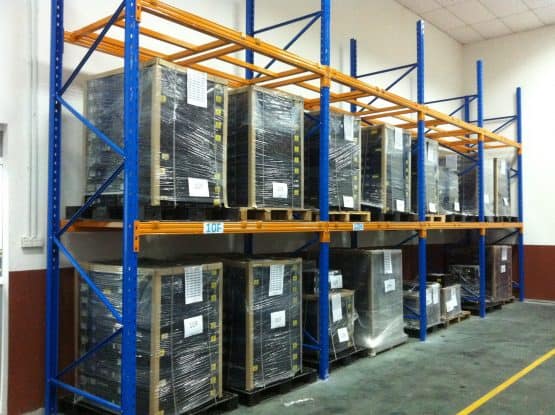

Fully adjustable to fit varioustypes, sizes, and weights of loads, selective racks only require small aisle widths, making them the optimal choice for storing and retrieving products within a constrained area.
Very narrow aisle (VNA) racking systems are compact and adjustable. With reference to selective pallet racks, they create a high-density storage system that increases warehouse capacity without requiring additional space.
Double-deep pallet racks store pallets at two depths rather than one, allowing for increased storage density. Unlike other pallet racking systems, warehouse operators will not have direct access to all the pallets stored. Instead, special forklifts are needed to easily access the second pallet. This pallet racking system is highly compact making it ideal for longer-term warehouse storage.

Drive-in/drive-through racking system is a high-density storage solution that maximises available floor space and height. Drive-in rackings have one access aisle and operate on a LIFO (last-in, first-out) basis. Alternatively, drive-through rackings have an entrance and exit aisle and operate on a FIFO (first-in, first-out) basis. Both pallet racking systems are ideal for the storage of homogenous products in bulk quantities.
To increase the stability and safety of pallet racking systems, they can be supplemented with the following accessories:


Start by auditing your current and projected inventory total number of pallets, pallet sizes, load type, and weight per pallet. Divide your warehouse floor area by your intended aisle configuration to determine how many bays fit within the space. Multiply bays by levels to get total pallet positions. Factor in your throughput rate to ensure the storage system supports efficient picking without bottlenecks. Consulting a specialist like Aracking is recommended; they can conduct a site survey and calculate the precise storage capacity needed for your specific warehouse layout and operational requirements.
Before installation, evaluate your warehouse dimensions (height, column spacing, floor loading), the range of pallet sizes and load types you need to store, and how frequently each pallet needs to be accessed. Your forklift type determines the minimum aisle width required, which directly affects storage density. Budget, future scalability, and MOM WSH Act compliance, including load notices and structural inspection requirements, are also key considerations. A thorough site assessment by a qualified racking supplier ensures the storage system is matched correctly to your storage needs before any commitment is made.
Yes. Pallet racking systems are highly adaptable and can be configured to suit a wide range of warehouse layouts, including irregular floor plans, low-clearance buildings, and spaces with structural columns. Frame heights, bay widths, beam levels, and aisle widths can all be adjusted to maximise storage capacity within your specific footprint. Accessories such as wire mesh decking, pallet support bars, and safety barriers can be added to accommodate different load types and operational requirements. Aracking designs each installation from scratch to meet the precise storage needs of your warehouse.
Aisle width depends on the type of forklift used in the storage system. Standard counterbalance forklifts require aisles of 3.5m to 4.5m, whilst reach trucks operate in 2.4–3.0m aisles, and Very Narrow Aisle (VNA) machines can work in as little as 1.6m to 1.8m. Wider aisles improve accessibility and throughput speed but reduce overall storage capacity. Narrower aisle configurations increase pallet density but require specialised equipment. The right balance depends on your pallet sizes, stock rotation frequency, and the investment of machinery in your warehouse.
Compatibility depends on the pallet racking configuration. Selective pallet racks work with standard counterbalance forklifts and reach trucks, the most common equipment in Singapore warehouses. Double-deep racks require reach trucks with extended-reach capability. Drive-in and drive-through systems use counterbalance forklifts that enter the racking structure directly. VNA racks require specialist narrow-aisle or turret trucks. Matching your existing equipment to the correct storage system is critical; the wrong forklift in the wrong aisle width creates safety risks and load type handling errors. Aracking advises on compatibility during the site survey. Do take note of the max lifting height of your forklift and design the rack suitable for such.
Under Singapore’s MOM WSH Act, warehouse operators are responsible for maintaining racking in a safe condition at all times. As a minimum, visual inspections should be carried out monthly by trained warehouse staff, checking for bent uprights, damaged beams, dislodged safety pins, and overloaded bays. A formal structural inspection by a qualified person is recommended at least annually, or following any forklift collision. Any damaged component must be taken out of service immediately and replaced before the bay is reloaded. Maintaining a documented inspection log is best practice and supports WSH compliance.
Yes, one of the core advantages of a pallet racking system is its modular, bolt-together construction. Bays can be added, removed, or repositioned without welding or permanent structural changes, making it practical to adapt the storage system as your storage needs evolve. Beam heights can be adjusted to accommodate different pallet sizes or load types, and entire runs can be dismantled and reinstalled in a new location. This flexibility makes pallet racking a cost-effective long-term investment compared to fixed storage infrastructure. Aracking can assist with reconfiguration and installation wherever your operations move.
The most frequent mistakes include underestimating load requirements, specifying a system rated below the actual weight of goods stored and choosing a configuration based on upfront cost rather than operational fit. Insufficient aisle widths for the forklifts in use, failure to anchor uprights correctly to the warehouse floor, and neglecting MOM WSH compliance (load notices, inspection schedules) are also common. Some businesses overlook future scalability, selecting a storage system that cannot be expanded to meet growing storage capacity needs. Engaging a specialist supplier like Aracking from the outset avoids the majority of these costly errors.


